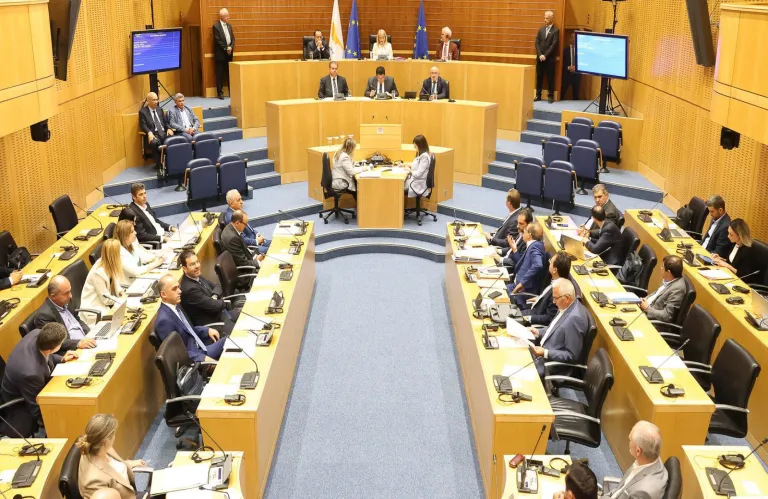
The timelines for civil and criminal cases submitted by Cypriot courts to the European Commission and included in the 2025 Rule of Law Report on Cyprus, present an artificially rosy picture. In reality, the delays are far worse, Cyprus Bar Association president Michalis Vorkas told the parliamentary Institutions Committee last week. He pointed out that hundreds of cases have taken more than a decade to conclude, with some dragging on for as long as 17 years.
Only 48 hours after his 3 September warning, reality proved him right: a libel case ended after 17 years, with both the first-instance and appeal courts ruling in favor of Phileleftheros' journalists. The case had drawn widespread public attention in 2008 after the paper reported that mouse droppings had been found in bread, leading to the closure of a flour mill following Health Services inspections. Later, State Laboratory analyses showed the bread contained no droppings. Nevertheless, the media group won the libel case, securing a key appellate ruling that shields journalists and media from abusive lawsuits aimed at silencing them.
Supreme Court: “We Do Not Falsify”
During the Institutions Committee session, the Supreme Court came under strong criticism from Vorkas and MPs Dimitris Demetriou (DISY), Andreas Pasiourtides (AKEL), and Alexandra Attalides (independent), who claimed that the European Commission’s Rule of Law report presented an artificially improved image of case hearing times in Cyprus.
In its statement, the Supreme Court dismissed allegations of misleading the European Commission or falsifying data, stressing:
“The Judicial Service annually submits to the European Commission for the Efficiency of Justice (CEPEJ) statistical data on the number of cases pending at the beginning of the year, as well as the number registered and completed during the year. This is done without any processing, evaluation, or assessment. The figures provided are exactly those requested by the committee and are entirely accurate. They are used to prepare the European Commission’s EU Justice Scoreboard. CEPEJ, using a common methodology for all member states, calculates average case durations. The problem of delays in adjudication is real. However, the favorable observations on Cypriot justice in the annual report are the result of substantive work achieved and reflected in the actual numbers.”
Bread and the Evidence
The facts behind the libel case, which was finally decided last Friday after 17 years and released yesterday, are as follows: On 4 February 2008, a consumer brought bread containing a foreign substance, claimed to be mouse droppings, to the Public Health Services in Paphos. The sample was sent to Nicosia for analysis. Authorities traced the bread to a bakery that sourced its flour from a specific mill.
The next day, officials inspected the mill and found:
(a) flour and animal feed produced in the same area,
(b) hygiene violations and shortcomings,
(c) mouse droppings in the flour production area.
The mill was shut down for four days, the order renewed for another four and lifted on 14 February 2008 after re-inspection. Authorities publicly named the mill, citing serious hygiene violations that could endanger public health.
Case Dismissed
Phileleftheros published two articles on 6 and 7 February 2008, titled “Mouse Droppings in Bread” and “The Droppings and Nitric Acid.” The mill filed a libel suit seeking damages of more than €80,000, citing, among other things, the State Laboratory report which had not detected mouse droppings.
The Court dismissed the lawsuit against Phileleftheros and its journalists, upholding the defense of truth. According to the ruling, the publications reflected reality, since at the time of publication the plaintiff was producing flour for human consumption without being registered in the Public Health Services’ registry, and traces of rodents (droppings) were indeed found on the premises.
Why the Ruling Matters
The mill appealed, citing 12 grounds. The Court of Appeal confirmed the first instance ruling, highlighting two key points:
- The refusal of Phileleftheros and its journalists to publish the later State Laboratory report (11 March 2008, about a month after their articles) that found no droppings in the bread cannot be seen as bad faith.
- In libel law, the truth of allegations is judged on the information available at the time of publication, not on later findings.
Ultimately, both rulings carry weight well beyond the specifics of the case. They protect journalists and news outlets from abusive libel actions designed to intimidate or silence, and they send a clear message that the defense of truth remains the cornerstone of press freedom in Cyprus.